
|
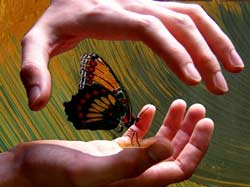
A young skeptic, wishing to test the wisdom of a rabbi, held his closed fist before the venerated sage. "What have I in my hand?" the youth asked. "A butterfly," was the answer. "Is it alive or dead?" queried the youth. The wise old man knew that the youth was sporting with him. If he replied dead, the youth would open his hand and let the butterfly fly away. If he replied alive, the youth would close his fist and crush the creature. The seer replied, "It is in your hands–-whatever you desire to make of it."
|

In October of 1971 I came to Crown Heights from Kentucky and enrolled in Yeshiva Hadar HaTorah, the very first yeshiva for baalei teshuva — young men like myself who were new to Torah learning.
The Yeshiva's 76-year-old founder, Rabbi Yisrael Jacobson, obm, looked upon me as a child of his old age.
Months later, Rabbi Jacobson said to me with a glowing smile, "You don't have to worry about paying for anything anymore. Just give me your cameras, and you will be able to learn without distractions."
But my cameras were my freedom and my sole means of support.
Determined to keep my options open, I said, "I will go to Yeshiva full-time, but I still want to support myself by photography."
The following week, I arranged to meet a wedding photographer in Far Rockaway, Queens. It was about 10 pm when I took the IRT bound for Manhattan — my first solo subway trip.
It was after one o'clock when I boarded the subway train to return to Crown Heights. The train ride seemed to go on forever, and, as all the maps in the deserted train were obscured by graffiti, I had no idea where I was.
When the train pulled into a station I got out and headed for a toll booth, relieved to find a black gentleman sitting there reading a Bible.
"Sir, could you tell me how to get to Crown Heights?"
"Take the AA to Manhattan, and change at 42nd for the 2 to Brooklyn. On Saturday nights the AA runs but once an hour. You should have stayed on that train."
I sighed. It was 2:45 a.m.
"There's a shortcut, if you're interested," he said.
He sketched a map on a scrap of paper. "Go out those doors, take a right, and at the corner of the building, you'll see a fence with a hole. Climb through it and follow the tracks.
"At the end of this field, you'll see an old, swinging bridge hanging across the tracks. Cross it. On the other side there's a staircase going into an alley. Make a right into the alley and follow it for 5 or 6 blocks. On your right, there'll be an elevated platform for the IRT."
"By the way, where I am?" "East New York," the man answered.
I headed out of the station. A mangled chain-link fence connected the station to a bridge abutment. I crawled through the hole in the fence and saw the path leading to a field littered with rotting garbage, rusty car fenders and other refuse. Pressing on, I came to the swinging bridge, and walked gingerly to its center. I surveyed the panorama: bombed-out tenement houses, garbage heaps, graffiti.
I crossed the bridge, went down the staircase and — just as the man described — stepped into a dark alley.
"Empty your pockets!" A voice growled from the darkness.
A black man, aged 24 or so, walked up to me and pressed a .38 revolver into my chest.
Click. He cocked the gun's hammer.
"Empty your pockets before I kill you," he barked.
I pondered the double meaning of his words and concluded that I was probably about to meet my Maker.
"Before I empty my pockets," I said, looking straight into his fierce eyes, "there is something you must know: G‑d gave everyone seven basic commandments and one of them is 'Thou shall not steal.'
Now that you know this, if you steal from me, you will lose your portion in the World to Come."
After a moment of silence, he frothed, "I hate Jews!"
Just then, another man emerged from the shadows carrying a large club. "Yo man, what's taking so long?" the club man asked the gunman.
"This Jew is giving me jive," the gunman responded. "Shoot him," he retorted.
"Let me explain," I said, and I again went through the scenario of the Seven Commandments. I told him that if he stole from me he would forfeit Eternal Life.
The club man said angrily, "Is your G‑d white? I don't like no white G‑d."
"My G‑d is invisible," I answered, "Yet, He is the Creator of all colors."
They seemed placated by my words, so I continued. "You know, if you don't steal from me, G‑d will owe you. When the time comes, He's going to pay you."
Silence.
Then, the club man said to the gunman, "He is a jiving Jew! I'm going to empty his pockets."
"Put your hands up Jew boy," the club man said.
His hand searched my pocket. His fingers became tangled in my tzitzit, (ritual fringes) and he couldn't reach the money in my pocket. He pulled his hand out, but the tzitzit held fast. He suddenly became terrified. Frantically, he untangled the strings from his fingers and jumped behind the gunman.
"This Jew's got pocket guards," he said.
Both men examined my tzitzit. They argued vehemently about whether my tzitzit were strings or elastic bands, then growled, "What are those things?"
"You see these knots?" I said, showing them the knots made from the strings. "There are five knots. Coming out of these knots are eights strings. Five plus eight is thirteen.
The strings are called 'tzitzit' in Hebrew.
The numerical value of the letters of the word 'tzitzit' add up to 600.
Six hundred plus 5 knots, plus 8 strings, is 613, which is the number of commandments G‑d gave to the Jewish people.
These tzitzit always remind us of G‑d and His commandments."
There was silence followed by a long "Naah, you puttin' us on."
"I'm telling you the truth," I answered. "I want to see your G‑d. Where can I see your G‑d?"
I answered, "G‑d fills the world, transcends the world, and is continuously creating the world anew. In fact, He is creating this whole scene right now. G‑d is also creating you, but because you have chosen to do evil, you are nothing more than a stick in G‑d's hands."
The guy with the club walked away, disappearing into the shadows. The other guy approached me. "Where are you headed?" he asked.
"I'm trying to get to the number 2 train," I said.
"Man, you gonna die six times before you reach the number 2. But don't worry. I'm going to protect you."
Taking the gun in his left hand, he draped his right arm over my shoulder and escorted me to the platform.
The next day I told Rabbi Jacobson what happened.
With very little coaxing, Rabbi Jacobson convinced me to fork over my cameras, and supported me while I studied in yeshiva for the next four years.
Many new parents are surprised when Dr. Eliezer Goldstock arrives at their door, toting a bouquet of flowers and saying "mazal tov."
The confusion comes not only because nobody in the house knows Dr. Goldstock, but also because the parents he visits have just given birth to a disabled child, and few have celebrating on their minds.
Chairman of Heart to Heart: The Jewish Academy for Distinguished Children, Dr. Goldstock believes children with special needs have something vital to offer their families: the chance to "come out of ourselves," he said.
Dr. Goldstock is helping to establish a network to support new parents of disabled children all over North America. His goal is to rid parents of their fear in dealing with such children and to convince them that their Jewish children belong in Jewish homes. "Three thousand Jewish babies with special needs are given away each year to non-Jewish parents," he said. "I'm not going to judge anyone. But let me come to you and at least try to help you out."
Dr. Goldstock established the Jewish Academy last year after his fifth child, Sara Mushka, was born with Down's Syndrome. "Don't become attached to her," the pediatrician warned. "Down's Syndrome children always die young."
A psychologist in private practice, Dr. Goldstock refused to accept the pediatrician's advice. Instead, he began searching for a relationship with his child to parallel man's bond with G‑d. "What do we ask from G‑d?" he said. "We ask understanding, mercy and compassion. This is what a child seeks from its parent—all the more so with distinguished children."
Dr. Goldstock began to contemplate, "What is the neshama (soul) of a special child?" His answer came when he was attending a fund-raising event. A man pointed to a certain guest and asked Dr. Goldstock, "Do you know what he's worth?"
"Yes," Dr. Goldstock responded. "He's worth exactly what my daughter is worth."
Many mothers say they don't think their other children will accept the new baby," says Dr. Goldstock's wife Chana. "Many worry what the neighbors will think. One mother did not go out with her baby for a whole year. She just couldn't stand it if people would stare at her."
"It hasn't been easy," he said of raising his own Down's Syndrome daughter. But Sara Mushka, now 20 months old, is the family's treasure, nonetheless. "She has something to contribute," he says. "And she's drawn us all closer together."
Dr. Goldstock hopes to teach this approach to new parents of children with special needs. He begins by bringing them flowers after their baby is born. "Sometimes they're interested," he said. "Other times, they throw me out. So I leave my card behind. Often, they'll call me later."
His first concern is to discuss causes of the ailment and what expectations parents can have of the child. "When you're armed with information, it dispels all the myths," Dr. Goldstock said. "Without fear, you can do anything."
Information can also mean counselling the parent who insists that his special-needs child is a punishment from G‑d or some kind of genetic misfit. "Man was created in the image of G‑d," he said. "G‑d doesn't make mistakes."
Chana advises other mothers not to make major decisions when they are emotional. Some mothers do in fact decide to keep their children after speaking with Chana. In some cases, a mother may decide to give her infant to a foster home rather than to adoption so she can eventually take her child back if she changes her mind. One mother said that she would never have accepted Chana's recommendations if she had not gone through similar problems.
If parents are not interested in keeping their child, Dr. Goldstock will help direct them to an agency that can place the child in a Jewish home. "We have five families waiting to adopt each child," said Dr. Goldstock.
"We are the tribe of Israel; we should at least take care of our own," he said. "I've seen children in wards. They know they've been abandoned. They feel totally lost in the world.
Based in Brooklyn, N.Y. Heart to Heart also has branches in Los Angeles and Toronto. Its name, says Dr. Goldstock a Lubavitcher chasid, came to him from the Lubavitcher Rebbe's interpretation of the Torah passage which states that just as one's face is mirrored in the water, so a person's heart is reflected in another person's heart.
"In the mirror, you can see yourself even at a distance," Dr. Goldstock explained. "But to see yourself in the water, you have to come very close. That is the essence of our organization."
The Jewish Academy has two new projects. The first is raising funds to purchase equipment, such as walkers, wheelchairs and pediatric toys, which will be lent at no charge to children with special needs.
The second is to be able to inform any Jew in North America with a disabled child about services available in his area.
Moshiach Matters
Moshiach will stand and pray, girding himself as a hero before Him Who spoke and the world was.
Moshiach will say before Him, "Master of all worlds! I remember worry and grief, darkness and gloom. I saw no light, I heard great disgrace, and I cried for myself. My heart broke, and my stomach failed. I did not do this thing for my honor or for that of my father's house. I did it for Your honor, Your nation, Your Temple, and Your children, who are enveloped in pain among the nations!"